Trivia Madness
Gimica GmbHTrivia
4.41.77K Reviews
- Version
- 1.8.0
- Installs
- 1.00M
- Age Rating
- Everyone
Screenshots
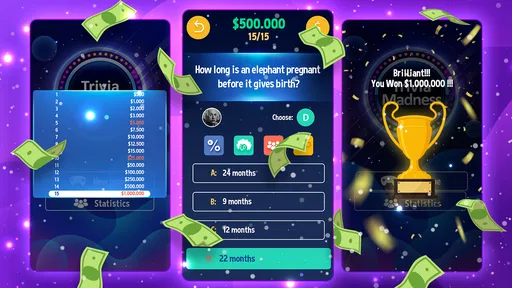
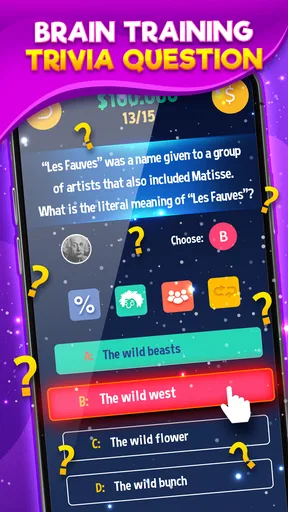
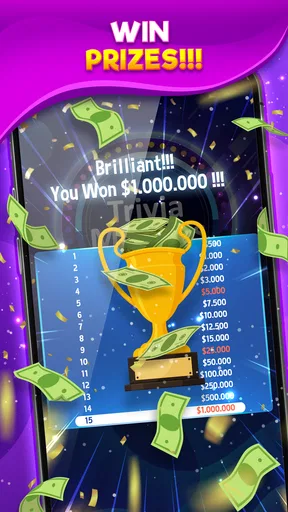
Our Review of Trivia Madness
 Analysis by Appyee
I like trivia games most when they make me think quickly without turning a short break into a serious commitment. Trivia Madness fits that mood well. It is a free trivia game from Gimica GmbH, aimed at players who want to answer quiz questions in brief bursts rather than settle into a long story campaign or a complicated strategy system. After spending time with it, I see its main appeal in the simple question-and-answer loop: open the game, read a prompt, make a choice, and keep going.
That simplicity is also the reason I would recommend it selectively. It works nicely for casual play, family moments, and anyone who enjoys testing general knowledge, but it is not the right pick if you want deep explanations, a carefully structured learning course, or a large collection of specialized quiz modes. The game is listed for Everyone, costs nothing to start, and has reached over one million installs. Those details match the kind of accessible, low-pressure experience it tries to provide.
Its average rating is 4.4 from around 37 thousand ratings, with roughly 1.8 thousand written reviews. I would not treat those figures as a guarantee that every player will enjoy it, but they do suggest that the straightforward format has found a broad audience. The important question is whether you personally enjoy quick trivia decisions, because that is where the game places nearly all of its weight.
Why the question-and-answer loop matters
The central capability here is not a complicated feature but the way the game turns spare minutes into small tests of recall. A trivia question gives you a clear task, and the answer you choose immediately determines whether your knowledge, intuition, or lucky guess carries you forward. I found that this creates a useful rhythm: the game is easy to understand within moments, yet individual questions can still make me pause and reconsider what I think I know.
That rhythm is more important than it may sound. Many mobile games ask players to learn menus, collect resources, manage upgrades, or wait for progress systems to unfold. This one puts the mental challenge first. If I have only a few minutes before an appointment, I can play without needing to remember a complicated objective. If I return later, the basic purpose remains obvious.
The real strength is immediate mental engagement without a long setup. I do not need to prepare a study session or arrange a group before opening it. A question can become a tiny conversation starter, a quick self-test, or simply a way to break up repetitive scrolling. That makes it especially suitable for people who enjoy general-knowledge quizzes but do not want a dedicated educational platform.
There is a trade-off in this focus. A question-based game can feel repetitive if you expect a changing adventure, character development, or a strong sense of place. The satisfaction comes from answering well, not from building a world. Players who need visual spectacle or a persistent progression story may find the experience too narrow after the novelty of the quiz format fades.
How I use it in short sessions
In practice, I approach it as a pocket quiz rather than as a game that demands a fixed daily routine. I open it when I want something more active than watching short videos, but less demanding than a full game. The low entry barrier is useful: I can concentrate on the current question instead of spending the first few minutes remembering controls or deciding which mission to pursue.
The best way to play is to treat each answer as a decision, not as a race to tap randomly. I read the entire question, remove options that clearly do not fit, and then compare the remaining possibilities. That small habit makes the game more satisfying because I am exercising reasoning as well as memory. When I genuinely do not know an answer, I try to notice why one option feels plausible instead of pretending that every mistake is meaningless.
This also exposes one of the format’s limitations. Trivia questions often depend on broad background knowledge, and a wrong answer can leave me curious rather than informed. If the game does not give enough explanation after a mistake, I may remember that I failed without understanding the subject better. For casual entertainment, that is acceptable. For serious learning, I would pair it with a reliable reference or choose an app designed around explanations and lessons.
A practical routine is to use it in two different ways. On a quiet break, I play slowly and think through uncertain questions. In a social setting, I let friends or family discuss the options before choosing. The second approach changes the experience: an answer becomes a prompt for conversation, and people can contribute knowledge from different areas. It is a better use of the game than silently tapping through every question while distracted.
A realistic everyday scenario
Imagine waiting for a bus after work. I have enough time to be bored, but not enough time to begin a console game, read a chapter, or watch something that needs uninterrupted attention. Trivia Madness fits that gap because the activity is divided into small decisions. I can play for a short while, put the phone away when the bus arrives, and return to another activity without feeling that I abandoned a complicated task.
It also works during a relaxed evening with another person. One player can read a question aloud while the other explains their reasoning. Even when neither person is certain, the discussion can be entertaining. I would not present it as a complete party game, because its main design remains individual quiz play, but the questions can support casual interaction without requiring a separate setup.
For parents, the Everyone age rating makes the game easier to consider for a broad household audience. I would still supervise younger players according to my own family’s preferences, especially because general trivia can vary in difficulty and subject matter. The age label makes it approachable, but it does not automatically turn every question into a teaching moment.
Where it sits among trivia alternatives
Compared with a dedicated learning app, this game is more immediate and less structured. A learning-focused alternative may organize subjects into lessons, explain mistakes in detail, or track a deliberate curriculum. Trivia Madness is better when I want the challenge itself, not a planned course. I can test what I already know, but I should not expect the same depth of instruction.
Compared with a multiplayer quiz platform, it is more convenient for solo use and quick interruptions. A competitive alternative may be more exciting when friends are online or when live rankings matter. This game is a better fit when I do not want to wait for opponents, coordinate a match, or commit to a particular time. The trade-off is that solo trivia may feel less energetic for players whose main motivation comes from beating other people.
Compared with a large quiz database or a specialist trivia title, its broad appeal is also its weakness. General questions are easy to approach, but specialists may want a narrower focus on history, science, sport, language, or entertainment. If I already know that I only enjoy one subject, a focused alternative will probably give me more meaningful challenge. This game makes more sense for mixed interests and unpredictable short sessions.
What the experience gets right—and where it asks for patience
The free price removes the biggest barrier to trying it. I can install the game without planning a purchase, see whether the question style suits me, and decide from actual play rather than from a description alone. That matters for a casual title: the main value is personal fit, and the cost-free starting point makes experimentation easy.
Still, “free” does not mean the experience will satisfy every expectation. Mobile trivia games can become tiring when the same basic action is repeated for too long, and this one is most enjoyable when I keep sessions moderate. I prefer treating it as a series of small visits instead of forcing myself to play until the questions blur together. Stopping while I am still curious helps preserve the appeal.
Another friction point is the difference between recognition and understanding. Getting an answer right feels rewarding, but it does not necessarily mean I could explain the topic. Likewise, missing a question can be frustrating when I receive a result but not enough context to remember the lesson. For that reason, I use the game as a knowledge check and conversation tool, not as my only source for learning facts.
Players should also consider how they respond to uncertainty. Some people enjoy guessing and accepting occasional misses; others dislike questions where they have to choose between two plausible answers. If I fall into the second group, the game may feel more irritating than relaxing. A slower quiz app with detailed explanations would be a better alternative for careful study, while a live competitive game would be better for someone who wants pressure and social excitement.
The current version is 1.5.0 and it supports Android 7.0 or later. That makes it accessible to people using older compatible Android devices, although I would still check the device’s available space and general performance before installing any mobile game. The version information is useful when deciding whether an older phone can run it, but the more important practical test is whether the screen, controls, and question pace feel comfortable on that device.
Small habits that improve the experience
My first tip is to separate confidence from speed. I answer quickly when the solution is obvious, but I slow down when two options compete. That prevents the game from becoming a sequence of careless taps and makes each question feel like a small reasoning exercise. It also gives me a clearer sense of which subjects I actually know and which ones I only recognize vaguely.
My second tip is to use wrong answers as a personal review list. When I miss something interesting, I make a mental note and look it up later from a trustworthy source. This turns a limitation into a useful workflow: the game supplies the prompt, while another source supplies the depth. I would not do this for every question, but it works well when one mistake exposes a genuine gap in my knowledge.
My third tip is to avoid using it while multitasking. Trivia seems casual, but distracted play makes the result less meaningful. If I am also watching a video or answering messages, I may miss a word in the question and blame my knowledge for an attention problem. Giving it even a few focused minutes produces a fairer challenge and makes the short session more rewarding.
A fourth useful approach is to play with different expectations depending on the setting. Alone, I use it to test recall and reasoning. With another person, I use questions as conversation prompts. With children, I focus on discussing why an answer might be right rather than treating every miss as failure. The same simple capability can serve these situations, but only if I adjust the way I play instead of expecting the app to provide a completely different mode.
Who will enjoy it most
I think the strongest audience is people who like broad trivia, want a free game, and value quick access over elaborate systems. It suits commuters, casual players, families looking for a simple shared activity, and anyone who enjoys discovering that a supposedly easy question is harder than expected. The Everyone rating also makes it a reasonable candidate for a mixed-age household, with normal parental judgment applied.
It is less suitable for players seeking serious competitive rankings, a rich multiplayer structure, or a guided educational program. It is also not my first recommendation for someone who only wants specialist questions. A focused quiz app can provide a stronger challenge in one field, while a live multiplayer alternative can create more tension and social energy.
Gimica GmbH has kept the concept approachable, and the game’s popularity suggests that this accessibility is part of its appeal. I would choose it when I want a lightweight trivia session that starts quickly and does not demand a large time investment. I would skip it when I am looking for a narrative game, a detailed course, or a quiz experience built around explanations rather than answers.
My final view is positive but measured. Trivia Madness is not trying to replace a textbook or become a deep multiplayer competition. Its value is narrower and clearer: it gives me a convenient way to challenge my general knowledge in small bursts. If that is what I want, the free download and simple format make it easy to try. For quick, accessible quiz play, it earns a place on my phone; for depth, specialization, or sustained competition, I would look elsewhere.
Privacy and Permissions
See what permissions an app requests and how it handles your data.
- Photos/Media/Files
- read the contents of your USB storage
- Storage
- read the contents of your USB storage
- Wi-Fi connection information
- view Wi-Fi connections
- Other
- view network connections, full network access, read terms you added to the dictionary, control vibration, prevent device from sleeping, Google Play license check
Verdict
Strengths of Trivia Madness
- Large variety of trivia categories keeps quizzes feeling fresh.
- Quick rounds make it easy to play during short breaks.
- Simple controls are accessible for most players.
- Competitive scoring adds motivation to improve your results.
- Questions can help reinforce general knowledge while playing.
Limitations of Trivia Madness
- Some questions may feel too easy for experienced quiz players.
- Difficulty and topic balance can vary between rounds.
- Repeated questions may reduce replay value over time.
- Competitive features may feel less enjoyable without active opponents.
- An internet connection may be required for some game features.
Other Releases by Gimica GmbH
View All


Similar Picks in This Category
View All
Millionaire 2026 Quiz & Trivia
Quiz & Trivia Games by Submarine Apps4.5

Brain Test 2: Tricky Stories
Unico Studio4.7

Trivia Crack: Brain Quiz Games
etermax4.4

QuizzLand. Quiz & Trivia game
Quiz & Trivia Games by Mno Go Apps4.8

Brain Test: Tricky Puzzles
Unico Studio4.7

Logo Quiz
bubble quiz games4.5
Frequently Asked Questions
What is Trivia Madness, and how does the game work?
Trivia Madness is a quiz game centered on answering questions across different categories, such as general knowledge, entertainment, history, science, sports, and more. After installing it, players typically choose a quiz mode or challenge and answer questions within a limited time or number of attempts. Correct answers help increase your score, while mistakes may reduce progress or end a round.
Can I play Trivia Madness without an internet connection?
Offline availability may depend on the specific version of Trivia Madness and the mode you want to use. Some quiz content can potentially be available after it has been loaded, but online competitions, leaderboards, advertisements, account features, and updated question packs generally require an internet connection. It is best to check the game description and test the main modes before relying on it for offline play.
Does Trivia Madness include multiplayer or competitive features?
Trivia Madness may offer competitive elements such as score comparisons, timed challenges, rankings, or matches against other players, depending on the version installed and the platform you use. These features can make the game more engaging for friends and quiz fans, but they may require an account or an active connection. Review the in-game menus and privacy settings before joining online competitions.
Is Trivia Madness free to download, and does it contain purchases or advertisements?
Trivia Madness can generally be downloaded without an upfront payment, although the exact pricing model may vary between Android and iOS. Free versions commonly include advertisements, optional purchases, extra lives, hints, cosmetic items, or access to additional content. Before downloading, review the store listing for in-app purchase details, and use parental controls if children will be playing.
Is Trivia Madness suitable for children and casual players?
Trivia Madness can be a suitable choice for casual players who enjoy short quiz sessions and learning through general-knowledge questions. However, age suitability depends on the content, advertising, online interaction, and difficulty of the questions. Parents should check the official age rating, review permissions, and supervise purchases or multiplayer features, especially if the app is being installed on a child’s device.
Play our best games!


